Golf, News
Top 10 Donald Ross Golf Course Redesigns
As Seen In Links Magazine
By Joe Passov
Ahead of the 2024 edition of the PGA Tour finale, Andrew Green revamped and restored many of East Lake Golf Club’s Donald Ross characteristics. Yet, East Lake was not a Donald Ross original design, but a Ross redesign of another architect’s work.
Although Ross is most renowned for his original creations, such as Seminole, Oak Hill (East), Oakland Hills (South), and Pinehurst (No. 2), he was also prolific in renovating existing courses. In some cases, he remodeled, in others he added bunkers, individual holes, or even entirely new nines.
Of the top 10 Donald Ross golf course redesigns cited by Links Magazine, three are notable Andrew Green redesigns, with another Andrew Green redesign in progress.
East Lake Golf Club—Atlanta, Ga.
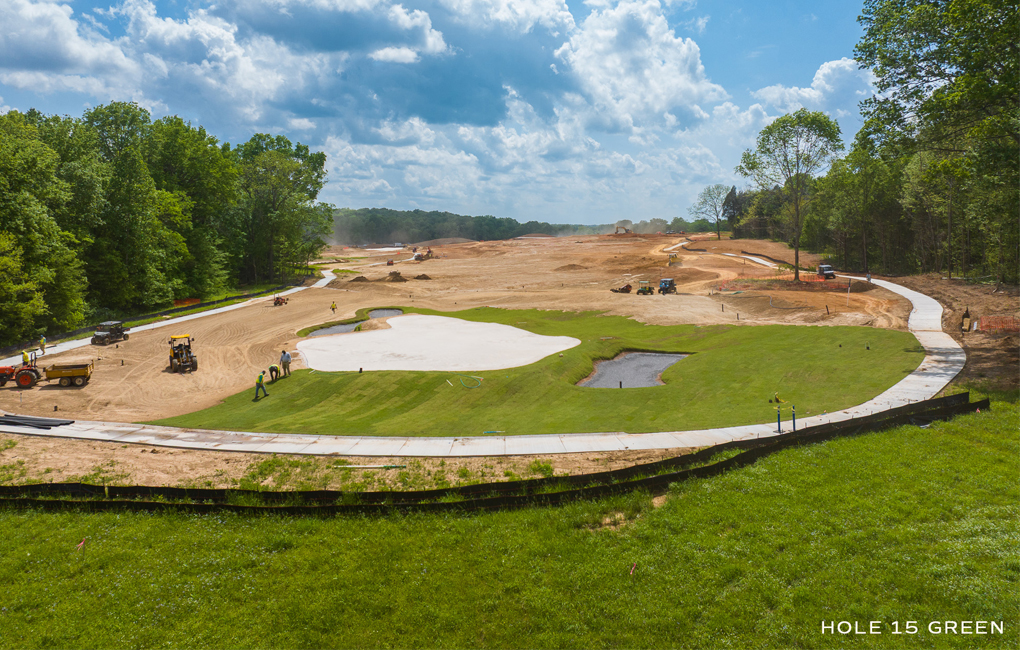
Tom Bendelow crafted Bobby Jones’s home course in 1908 and even though it was scuttled in 1913 when Jones was 11, Jones remembered it well: “It was sort of a strange layout as golf courses go, because it only had two par-three holes, the first and the third. The rest were short par fours and fives.” Donald Ross completely redesigned the course from 1913–15, George Cobb “modernized” it in 1959–60, and Rees Jones renovated it in 1994. Andrew Green restored the Ross to East Lake in 2023–24. One holdover on today’s Tour Championship course is the ancient peninsula green at the current par-three 15th—it served the par-five 16th on the Bendelow course. After discovering an aerial from 1949, Green was able to re-create many of the Ross greens, including shapes and contours, as well as much of the bunkering.
Inverness Club—Toledo, Ohio
Originally, Inverness was a 9-hole course of 3,098 yards designed in 1903 by successful English professional Bernard Nichols (more often spelled Nicholls) who on five occasions placed in the U.S. Open top 10 between 1897 and 1907. Nichols had defeated Donald Ross in a match at Pinehurst in 1902, earning $500 in the process. Ross got his revenge, however. In 1916, Inverness summoned him to completely revamp what had become an 18-hole layout, utilizing some newly acquired land to the south. In time, Inverness would host four U.S. Opens, two PGA Championships, and the 2021 Solheim Cup. It will host the U.S. Women’s Open in early June 2027 and will again be the venue for the men’s U.S. Open in 2045. An Andrew Green restoration in 2016–18—with additional tweaks in 2024—has transformed Inverness into the course that Ross would easily recognize.
Interlachen Country Club—Edina, Minn.
Initially a William Watson design from 1911, Interlachen was completely redesigned in 1919 by Donald Ross. It achieved early renown as the venue for the 1930 U.S. Open, won by Bobby Jones in his Grand Slam year, when Gene Sarazen declared that among championship layouts, only Oakmont was tougher. Interlachen’s small ridges, cunningly placed bunkers, and vexing greens provided sufficient challenge at the 1993 Walker Cup, 2002 Solheim Cup, and at the 2008 U.S. Women’s Open, but some of the teeth and design flourishes had vanished over time. Enter restoration specialist Andrew Green. At the conclusion of Green’s work in 2024, Interlachen looked as if Ross had done it himself. Green yanked out trees, widened landing areas, restored bunker complexes, and expanded greens to their original dimensions. Green also created or re-positioned a half-dozen greens, all in vintage Ross style. Interlachen’s restored Ross features will be on display when it hosts the 2030 U.S. Women’s Open.
Skokie Country Club—Glencoe, Ill.
Pioneer architect Tom Bendelow crafted the first version of Skokie in 1905, but that layout yielded to a much better routed track by Donald Ross in 1915. That’s the course where 20-year-old Gene Sarazen took the 1922 U.S. Open title on the strength of a final-round 68 for a 288 total, that included a two-putt birdie at 18, for a one-shot victory over Bobby Jones and John Black. Remarkably, the club elected to extensively remodel its Donald Ross U.S. Open course in the 1930s. William Langford of Langford & Moreau did the redesign and kept just six of the Ross holes. Most memorable is the 228-yard par-three 12th, which demands a carry over water to green perched eight feet above the water. There is a bailout short-left, but a miss short or short-right faces a vexing, steeply uphill shot from dense rough.
Charlotte Country Club—Charlotte, N.C.
Donald Ross didn’t design this venerable venue from scratch; rather, his work was a 9-hole addition in 1915, a redesign in 1925 when he converted the sand putting surfaces to grass, and a further renovation in 1942. Fred Laxton, a three-time Carolina Amateur champ, sculpted the first nine in 1910. Charlotte has played host to four USGA National Championships, including the 1972 U.S. Amateur, then held at stroke play, and won by Vinny Giles over Ben Crenshaw and Mark Hayes. It also hosted the 2000 Senior Amateur, the 2010 Women’s Amateur when Danielle Kang memorably bested Jessica Korda 2 and 1, and the 2018 U.S. Mid-Amateur. A restoration and renovation project from Andrew Green is in progress.
Seaview (Bay Course)—Galloway, N.J.
Donald Ross remodeled this Hugh Wilson (of Merion fame) design in 1914–15 that edges marshy Reeds Bay and delivers splendid vistas of the Atlantic City skyline. While some sources credit Wilson for the design and Ross for merely adding the bunkers, the consensus gives more due to Ross overall, including how the final set of greens turned out, which were larger, with more mounding, than what remains today. Parts of the Bay paired with its Pines sibling to host the 1942 PGA Championship, won by Sam Snead, and while only 6,366 yards, par 71 from the tips, the Bay is strong enough to test the best at the LPGA Tour’s annual ShopRite LPGA Classic, where winners include Juli Inkster, Annika Sorenstam, and Lexi Thompson.
Union League Golf Club at Torresdale—Philadelphia, Pa.
In February 2022, Andrew Green signed on to restore the Union League Golf Club at Torresdale in Philadelphia, a club with a convoluted history. Formed in 1921 by the merger of two 9-hole courses, Torresdale Country Club and Frankford Country Club, the course was redesigned by Donald Ross in 1921. Thereafter, it was known as Torresdale-Frankford Country Club, until its purchase and renaming by the Union League of Philadelphia in 2014. Located a mere 12 miles from downtown Philadelphia, it’s hemmed in by city boundaries, but packs a ton of golf into its 6,609-yard, par-70 layout, including the triple trouble of holes 6, 7, and 8. The 8th is the hardest and best of all, calling for a straight drive of no more than 329 yards to the end of the fairway, followed by a long approach over a slender water hazard that cuts across the fairway 30 yards short of the green.
Omni Bedford Springs Resort & Spa (Old Course)—Bedford, Pa.
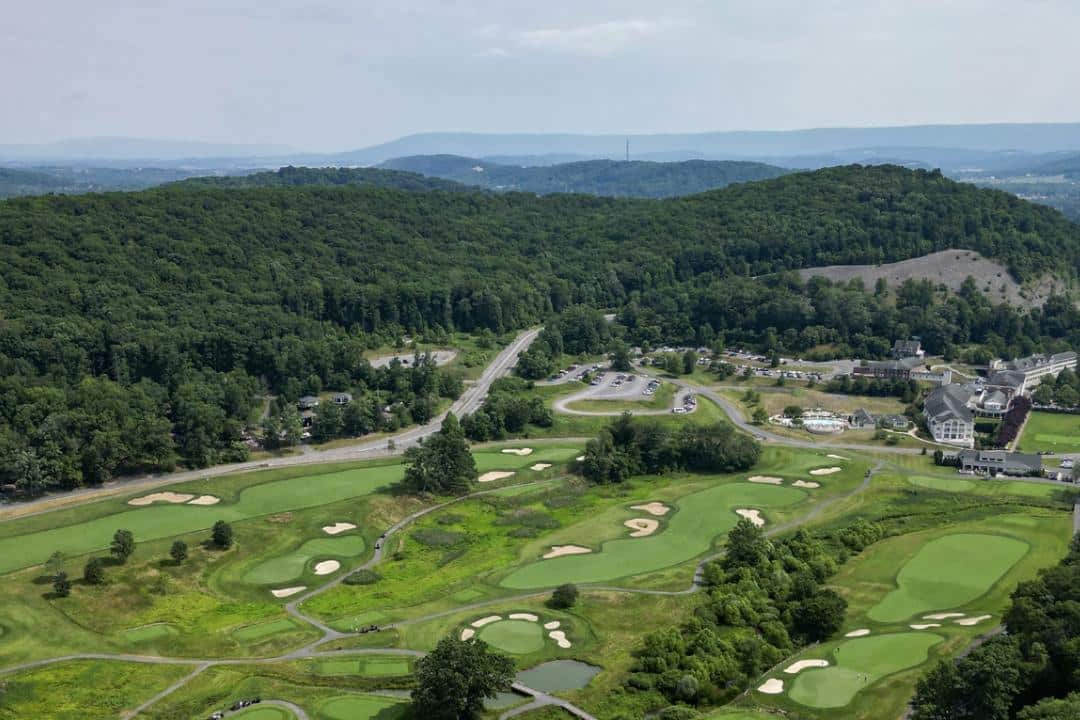
Tucked away in bucolic Bedford, a 90-minute straight shot east of Pittsburgh, Bedford Springs reopened in 2007 after a two-year effort led by restoration specialist Ron Forse. The course incorporates the design stylings of Spencer Oldham, who crafted the resort’s original 18 in 1895; A.W. Tillinghast, who renovated the course in 1912, cutting it back to nine holes; and Donald Ross, who added back nine holes and retooled the existing nine in 1923. Its hilly opening and closing stretches pair with Shober’s Run, a Gold Medal trout stream visible or in play on 12 holes, to render this 6,785-yard, par-72 track sufficiently testing for the modern game. But with 11 restored Ross routings, four from Tillinghast, and three from Oldham, at a resort that dates to 1796, purists just might be tempted to haul out the hickories.
Augusta Country Club—Augusta, Ga.
While Augusta’s oldest club dates to 1899, the design of its present golf course is attributable to its head progressional at the time, Scotsman David Ogilvie, who delivered the layout in 1909. Donald Ross was very busy in Georgia from 1925 to 1928, and Augusta Country Club enlisted him to revamp their layout in 1926–27. Understandably overshadowed by its Masters-hosting neighbor, Augusta National, Augusta C.C. makes several top 100 lists on its own, thanks to similar elevation change and a risk/reward par five, the 8th, that tangles with Rae’s Creek.
Omni Homestead Resort & Spa (Old Course)—Hot Springs, Va.
Golf at The Homestead goes back to the 1890s, and the venerable resort has long asserted that the first hole on its Old course employs the oldest first tee in continuous use in America, dating to 1892. By most accounts, the earliest course was six holes and was expanded to a full 18 by Donald Ross in 1912. William Flynn revised the Old in 1923, around the time he created the resort’s new Cascades course, and Rees Jones did additional renovation in the 1990s. At 6,099 yards, par 72, the Old is short on length but long on character, replete with hills amid the backdrop of the densely forested Allegheny Mountains. Most memorable is the 171-yard par-three 18th which boasts a handsome view of the Omni Homestead’s famous Kentucky redbrick clock tower rising through the trees.